
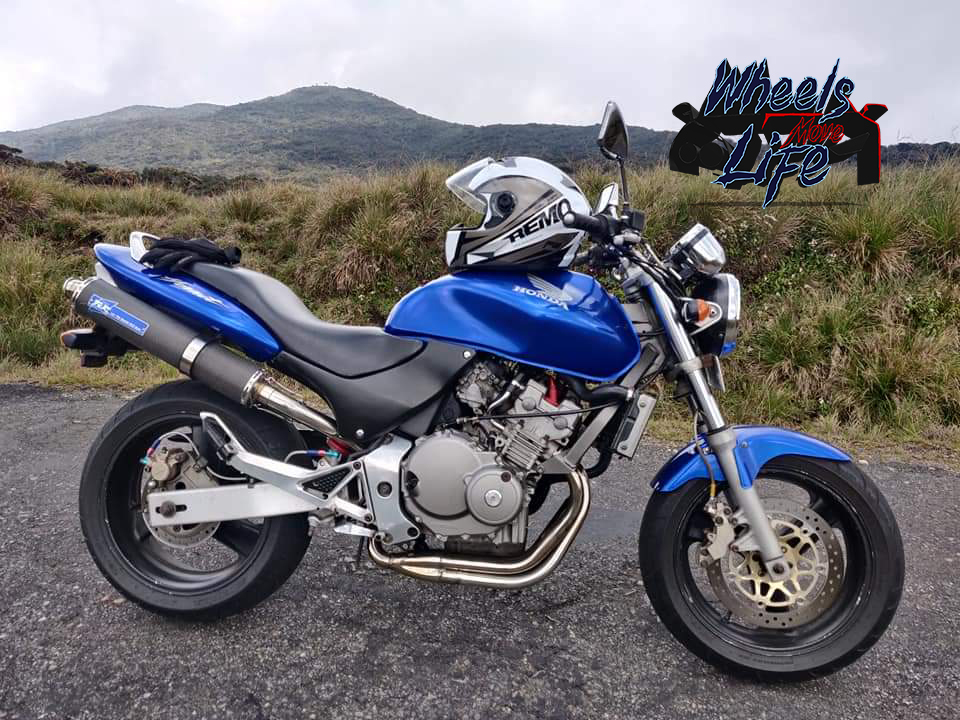

In today’s post let’s talk about one of the best bikes Honda made
in the 250 segment that is Honda CB250F, which is best known as Honda Hornet
250. In Honda’s history, this bike comes at third place in performance only
behind to Honda Jade 250 (40bhp) and Honda CBR 250RR Fireblade (45bhp) also
known as CBR Gullarm. But if we take the comfortability in long riders for
rider and passenger Honda Hornet 250 is in the first place.
Before going
further into the detailed review first, let’s talk about the production years
and the chassis number that related to the production year. There is a
significant difference between some production years, because of that so many
sellers tend to change the chassis number and sell the bike for a higher price.
Therefore, its best to be aware of the product code and the difference between
the production years.

1996 – CB250FT – MC31 100 or MC31-105, Engine number – MC14E-150
1997 – CB250FV – MC31 110, Engine number – MC14E-155
1998 – CB250FX – MC31 115, Engine number – MC14E-160
1999 – CB250FY – BA MC31 120, Engine number – MC14E-170
2000 – CB250F1 – BA MC31 125, Engine number – MC14E-175
2003 – CB250F3 – BA MC31 130, Engine number – MC14E-180
2005 – CB250F6 – BA MC31 140, Engine number – MC14E-190
2006 – CB250F7 – BA MC31 150, Engine number – MC14E-200
Next, let’s talk about the differences that happened with every
production year and chassis numbers,

1996 – CB250FT CH 100,105
In this year the engine was painted with Silver colour and bend
set (pipes that are connecting the exhaust to the engine) painted with Black
colour.
1997 – CB250FV CH110 and 1998 – CB250FX CH115
From this model onwards engine came in black colour and bend set
in silver colour
In CH110 and CH115 Only some minor differences were there in the
fork column and footpegs come in red colour in the CH 115 model. Also, the
speedometer came in white colour.
1999 – CB250FY CH120 and 2000 – CB250F1 CH125
From this production year onwards, the engine came with sensors
carburettor and bend set, chassis, engine all came in black colour. Also, the
brake disks had slight differences over the CH115 model. Until CH 115 model
Speed meter didn’t have a fuel gauge, but only a heat gage. After the CH120
model, the heat gage has been replaced by a fuel gauge. CH120 and CH125 had a
slight difference of MMS over CH100 and CH115, that improved the ride quality
and comfortability by a slight. Other than that, between CH120 and CH125 only
had differences in stickers only.
(adsbygoogle = window.adsbygoogle || []).push({});
2003 – CB250F3 CH130
From CH100 to CH125 we got plug tops and mono-shock in red colour,
but only in CH130 model, we got plug tops and mono shocks in yellow colour.
CH120, CH125, CH130 all had the same brake pads and disks. Until CH125 we had
Hornet logo on the tank but after CH130 the tank sticker is replaced by the
Honda logo and Hornet logo is moved to the hump (around the back seat). Before
CH130 all the brake callipers were light gold colour but after CH130 brake
callipers are changed to dark gold colour
2005 – CB250F6 CH140 and 2006 – CB250F7 CH150
From CH100 to CH130 chassis had a slight grey and black mixed
colour. But after CH140 bend set, forks, chassis, handle clip, hump holder,
everything came in black colour. Also, in CH140 model there was a Deluxe
edition. This model only came in two colours schemes. Only in CH140 deluxe and
CH150 deluxe the brake callipers were in black. Also, these two models had
crystal headlamps and in the meter panel, there was a Hornet logo near the RPM
meter. There is a slight difference in Handle grips from the CH130 model and
from CH140 onwards Honda used the same old brake disks which are used in the
CH100 – CH115.
(adsbygoogle = window.adsbygoogle || []).push({});
Until now we only discussed the differences between the chassis
numbers and the production years. From now onwards let’s continue with the
review.
Engine and Gearbox

If we talk about the engine first Honda Hornets engine is similar
to the Honda Jade 250s engine in so many ways, but with some improvements. This
engine has a 249cc DOHC four-stroke engine with 4 cylinders. With 4 valves for
each cylinder combined 16 valves and this engine outputs 40bhp at its maximum
RPM. The top speed is stated as 180kmph (111mph) but as per our knowledge, this
bike can reach up to 190kmph (118mph). This engine is a very costly engine to
maintain because Honda is no longer producing parts for this engine.

So, if you’re planning to buy a Hornet 250 make sure to check it
by a professional otherwise this bike will be a financial disaster for you and
also if you’re a Hornet 250 owner already make sure to service and maintain
your bike at the right time, by that you will be able to keep your bike like a
charm. This engine is cooled with a liquid cooling system same as the Jade 250.
(adsbygoogle = window.adsbygoogle || []).push({});

This bike is equipped with a 6-speed gearbox and a wet multiple
disk clutch. because of these wet multiple disks clutch it is very smooth and
easy to change the gears but in meantime, we need to keep in mind that the
clutch that is in this bike is more than 10 years old and to take care of that.
Fuel consumption and fuel efficiency

Hornet 250’s fuel supply is done with 4 Keihin Carburetors and its
fuel consumptions is around 20-25kmpl (45-50mpg). This fuel consumption is
achieved by tuning the carbs by the right amount. This bike is equipped with a
16-litre (4.2 gallons) fuel tank.

Suspension, breaks and tyers

as suspensions, Honda used telescopic forks for front and
monoshock for the back. Also, these are adjustable and for Hornets overall
comfortability these suspensions help a lot. For this kind of bike with this
kind of powerful engine, obviously, a great braking system is a must. To
achieve that breaking capability Honda used Nissin 296mm 4 piston callipers for
the front and 220mm 1 piston calliper for the back. For this capacity, these
breaks are more than enough

Hornet 250
comes out of the factory with 130/70ZR16 front tyers and 180/55ZR17 back tyers.
But if you want you can change the back tyre as big as 200. If you are buying a
Hornet keep in mind that these tyre sizes are usually used in superbikes so you
can imagine the prices are also in the same range.
(adsbygoogle = window.adsbygoogle || []).push({});
Chassis, overall appearance and handling

The cassis of this bike is made with steel diamond structure with
a hard frame, because of this structure at RPM redline you won’t feel any
vibrations at all and you will have so much control over the bike. When you try
to achieve the top speed of this bike, which is around 180kmph (111mph) you
will feel a vibration in the frame but that’s usual in any street bike.

As we talked
before this bike is equipped with an analogue meter and it has all the information
such as RPM, speed, odo, oil, trip, and fuel gauge. But until CH115 this meter
only had a Temperature Gauge(heat) after CH115 it’s replaced with a fuel gauge.
This bike weighs around 151KGs and the seat height is 760mm
(29.9inches) because of this any person of any height can right this bike
easily. But this bike requires a bit hustle to handle because of the weight and
the engine capacity after you get used to riding this bike you won’t even feel
that you’re riding a bike, this bike is that much comfortable. This bike only
has a ground clearance of 170mm (6.7inches) because of this when you are riding
over bumps you need to keep an eye on the bend set.

At last, if we talk a bit about this bike, Honda is not making 250
version of the Hornet right now. Most of the Hornet 250 that are in the market
right now don’t have the original paint. So before buying a Hornet 250 make
sure you check the paint also. Also, keep an eye on the engine number and the
chassis number, some tend to change these numbers to sell for a higher price.
Also refer Honda CBR 250 MC22
Honda made two more Hornet versions which are Hornet 600 and
Hornet 900. We will bring a review of those bikes ASAP so make sure to stay
tuned. Like our Facebook page to get the latest updates.
Until the next post, be safe and keep riding.
Copyright WML©2021.